URBANA, Ill. – A new generation of college students is making plans to transfer its passion for Jesus Christ from the campus to the mission field.
More than 10,000 students made commitments to become missionaries during Urbana 03, the world's largest mission convention for college students. The commitments, recorded on cards handed out at the end of the convention, are for short-term to a lifetime.
Students said Urbana 03, held Dec. 27-31 on the campus of the University of Illinois at Champagne-Urbana, made an unforgettable impact on them.
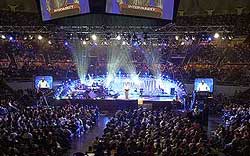
The 19,000 arriving students, missionaries and church and campus leaders transformed the state university campus temporarily into something like the world's largest Christian missions academy. They took over the classrooms, dorms, cafeterias and basketball arena vacated by regular students on winter break.
Many had traveled hundreds or thousands of miles to arrive at Urbana 03, and the eagerly anticipated convention did not disappoint.
Students lifted their voices and threw their hands into the air to worship God. They jotted notes as speakers voiced heartfelt personal stories about the rewards and challenges of missionary life.
Men and women from a number of nations and mission groups addressed the crowds, all sharing a common zeal for Jesus Christ and for telling the world about God's works.
(Those who did not attend can still taste some of the flavor of Urbana 03. The full Webcast of the general sessions – including speakers, worship, skits and announcements – was broadcast and is now archived on the Internet.)
The five days of the conference were long, invigorating and eventful.
Each morning, students gathered in small-group Bible studies in their dormitories, then walked in the unusually warm weather or rode buses to the Assembly Hall, the university's basketball arena, where they heard general-session teachings based on the Gospel of Luke.
During the afternoons, students fanned out to choose from among 300 seminars, and made their way to the cavernous exhibit hall, where they interacted with missionaries from more than 325 missions agencies, graduate schools and seminaries.
Each evening offered more general-session talks on the importance of proclaiming Jesus Christ across other cultures and faiths. Small groups met again in the dorms before bedtime.
Many participants said that as they listened, asked questions and prayed, God opened their hearts and minds, giving them insights and direction about how He wants them to serve in the Great Commission.
"Students in the 21st century will be the greatest missionary force the world has ever seen," said Jim Tebbe, director of Urbana. "Urbana helps students find their place in God's global mission."
Speakers challenged students to pick which kingdom they would live in – the kingdom of God's rule or of somebody else's rule.
"Am I going to set up my own kingdom where I choose what my future career holds, who I marry, where I live, and what I do with my money?" an article in the convention newspaper Urbana Today asked. "Is my culture going to tell me what is real, or will I look for how God wants to rule my culture, affirming some things, judging and redeeming others?"
The Urbana convention is held once every "student generation," usually once every three years. Almost all who attend the event say Urbana motivates them to serve God, but not all end up on the mission field. Urbana 03 students were a diverse group, with some tentatively exploring their opportunities and others committing themselves to being full-time mission workers.
Some students arrived at the conference as non-Christians and left as followers of Jesus. Eighty-seven people became Christians at Urbana 03, organizers said.
It is clear that the face of missions in the future will be diverse. About half of the convention participants were Asian, Hispanic, black or American Indian, and the rest were white, organizers said. Students from 120 countries attended.
One sad note was that John Stott, one of the world's foremost theologians and a beloved leader to generations of students, did not attend or deliver his planned keynote address to open the convention. Stott, 83, suffered a mild stroke four days before Christmas; doctors say they expect a reasonable recovery.
Stott's prepared address was delivered by close associate Joshua Wathanga, who encouraged students to pursue radical discipleship and to battle the prevailing culture of pluralism in order to win others to faith in Christ.
The convention's final evening included a hip-hop worship concert that got the entire crowd – with the exception of a few older members who couldn't decipher the words – swaying and waving their arms to the rhythm.
A solemn time of Holy Communion was followed by an ear-splitting New Year's praise party full of singing, flashing lights, and dancing to a Latino beat.
A hearty cheer arose when organizers announced that the collection taken up the previous day amounted to $1.1 million and would be divided among 11 mission agencies that serve the poor around the world.
InterVarsity, which has 810 chapters on more than 565 college campuses in the United States, is part of a network called the International Fellowship of Evangelical Students, which has links in 150 countries and is developing contacts in other parts of the world.
The largest IFES affiliate is in Nigeria, and the largest campus is in Rwanda, at the national university of Butare, where 1,500 meet in a stadium on Saturday nights and 500 attend daily prayer gatherings. The smallest IFES gatherings are in countries that cannot be named for security reasons.
Urbana 03 was InterVarsity's 20th student-mission convention. Since the first conference, in 1946, more than 200,000 people have heard the challenge to participate in God's global mission.
Because students say it is easy to feel overwhelmed by the volume of information and emotions swirling around them, InterVarsity offers post-convention aid to help students sort things out and take the next steps in missions.
Urbana 03 left students with a mixture of elation and realism about the challenges of cross-cultural and world missionary life. Speakers warned that God may call on some in the audience to suffer or give up their lives, or the lives of their family members, for the gospel.
But challenges awaiting Western missionaries, particularly in predominantly Muslim nations, should not dissuade or discourage the new generation from going, but instead cause them to trust God even more, speakers said.
Extraordinary opportunities are open to those who are not only courageous, but are willing to take time to form relationships with people they hope to evangelize, Patrick Johnstone, author of the missions resource guide Operation World, told religionjournal.com.
"It is more a challenge to a greater sensitivity and willingness to make the bigger effort to earn the right to witness," Johnstone said.


 Search:
 Subscribe:



 Email or