Thirteen conservative U.S. Episcopal bishops have formed a rival network of dioceses and parishes within the Episcopal Church.
The group, called the Network of Anglican Communion Dioceses and Parishes, is headed by Episcopal Bishop Robert W. Duncan of Pittsburgh, who was named moderator. He has been in the forefront of the Episcopalians who are challenging the direction of their church.
The network is not leaving the Episcopal Church, Duncan said. Instead, it hopes eventually to replace the Episcopal Church as the authentic branch of worldwide Anglicanism in the United States.
The network is composed of Episcopal dioceses and parishes that uphold historic Christian and Anglican faith and practice. Members have been angered by the Episcopal Church's approval of the Rev. Gene Robinson, who is openly gay, as bishop of New Hampshire (see religionjournal.com 11/09/03).
Beyond that, they have long disapproved of what they see as their church's drift from its biblical moorings.
"The Episcopal Church, in approving same-sex blessings and the consecration of the new bishop of New Hampshire, is saying God approves of this. God doesn't approve of this and that's a huge lie," Duncan said.
The new network "is a crucial component of Anglican realignment in North America," said the Rev. Canon David C. Anderson, president of the group and head of the American Anglican Council.
"It will serve as a lifeboat for orthodox dioceses and parishes who feel abandoned and betrayed by [the Episcopal Church] as well as for those faithful Episcopalians enduring harassment and intimidation by their rectors, bishops, or both," Anderson said.
The group's founding theological statement says pro-gay actions by the Episcopal Church and the Anglican Church of Canada's Diocese of New Westminster in Vancouver, British Columbia (11/02/03), have "torn the fabric" of the worldwide Anglican Communion and violated trust with other branches of Christianity.
Conservative bishops, clergy and lay delegates from the dioceses will hold a convention in Plano, Texas, Jan. 19-20 to approve an organizational charter and a theological platform.
The dioceses that have agreed to join the Network of Anglican Communion Dioceses and Parishes are Albany, N.Y.; Pittsburgh; San Joaquin, Calif.; South Carolina; Florida, Central Florida, and Southwest Florida; Dallas and Fort Worth; Quincy and Springfield, Ill.; Western Kansas; and Rio Grande, which is composed of parts of Texas and New Mexico.
The network will also include some dioceses and parishes in Canada and Mexico. Individual clergy and laypeople are expected to sign up.
Sixteen of the 38 top-ranking bishops and archbishops of the Anglican Communion have already said they will recognize the new network, news reports said.
The network's eventual goal is to win recognition as the authentic Episcopal Church from Anglican bishops overseas and from Roman Catholic, Protestant and Orthodox denominations that have already condemned the Episcopal Church for its actions, Duncan said.
Conservative Catholic, Protestant and Orthodox believers have harshly criticized Robinson's ordination. The Episcopal Church's General Convention also voted in August to acknowledge and approve that some dioceses are permitting gay-union ceremonies.
"What we trust is going to happen is that the rest of the world and the rest of the Christian community are going to bring such pressure to bear on the whole of this church that it steps back from this event," Duncan said, according to The New York Times.
Although formation of the new group is not yet being called a schism, it laid the groundwork for a confrontation with the leadership of the Episcopal Church, news reports said. The Episcopal Church has 100 dioceses in the United States.
If any foreign Anglican primate claims "oversight" of an American parish or diocese, or if Duncan claims such authority beyond Pittsburgh, it could force a schism in the church, James Solheim, director of news and information for the Episcopal Church, told the Times.
"That could unleash some forces that would deeply unsettle the whole Episcopal Church," he said. "An even more serious step would be if a bishop tried to take his diocese out of the national church. I think that would break loose quite a bit of litigation."
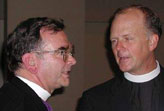
Photo: Bishop Robert Duncan (left) of Pittsburgh chats with the Rev. David Roseberry of Plano, Texas, a host of the AAC meeting in Dallas. (Jan Nunley of Episcopal News Service)


 Search:
 Subscribe:



 Email