The Episcopal Church has broken with 2,000 years of Christian tradition, making the Rev. Gene Robinson the first openly gay bishop in the modern history of Christianity.
Robinson's consecration ceremony, on Nov. 2, grafted him into "the faith of patriarchs, prophets, apostles and martyrs, and those of every generation who have looked to God in hope," according to the liturgy used at the ceremony.
Conservatives say the consecration was heresy.
"Heresy has been held up as holy. Blasphemy has been redefined as blessing. The hope of the transforming love of Jesus Christ has been denied. Holy Scripture has been abandoned and sin celebrated over sanctification,'' the American Anglican Council said in a statement.
"The world has now seen the foul fruits of 'anything goes' spirituality and the leaders that have pushed it in the Episcopal Church," the AAC statement said. "The Apostle Paul says: 'For the time will come when men will not put up with sound doctrine. Instead, to suit their own desires, they will gather around them a great number of teachers to say what their itching ears want to hear' (2 Timothy 4:3)."
Primates from Africa to Latin America expressed fury about the consecration, which pushed the 450-year-old, 70 million-member worldwide Anglican Communion into a crisis, separating liberals from conservatives.
"The devil has clearly entered the church. God will not be mocked," said Archbishop Benjamin Nzimbi of Kenya, who announced that his church will have nothing to do with the Episcopal Church, the American branch of the Anglican Communion, because it sanctioned Robinson's election and consecration.
"The United States [has] declared independence," said Archbishop Greg Venables, primate of the Southern Cone in South America.
Six U.S. dioceses have already begun realigning themselves in a new group organized by the American Anglican Council. A number of parishes announced they were changing their names and setting up independently of the national church, The Guardian reported.
Hinting of conflict to come, the Rev. Dan England, communications director for the Episcopal Church, said that while the denomination could tolerate dissident parishes and dioceses forming "an informal network," it would not look kindly on a new formal nongeographical province.
Many conservative members of the church are denying that Robinson, a 56-year-old cleric who is in a long-term relationship with another man, is a bishop, and they are refusing to have anything to do with him or his New Hampshire diocese.
"As far as I am concerned, he is not a bishop," said Peter Jensen, archbishop of Sydney, Australia.
As angry as they are, conservative Anglican leaders stopped short of declaring that their provinces had formally "broken communion" with the Episcopal Church. Such a declaration would mean they would not share the Eucharist with American bishops and might also refuse to attend church meetings with them or to accept missionaries from the United States, the Los Angeles Times reported.
Instead, a statement issued by Archbishop Peter J. Akinola of Nigeria, who has led the drive to denounce homosexuality, declared conservative provinces to be in a state of "impaired communion" with the American church.
Kendall Harmon, a leader in the American Anglican Council, which is working with conservative primates overseas, described impaired communion as "a further step of separation, which says that if there isn't a process of repentance, reparation and healing, we are headed toward broken communion – and that's the worst."
Akinola, speaking for about 20 primates from Africa, Asia and South America, said that he and the other leaders were "appalled" by Robinson's installation. He said that about half of the leaders of the 38 provinces that make up the Anglican Communion will refuse to recognize Robinson as a bishop and may regard clergy he ordains as invalid.
Akinola said that bishops in the liberal Episcopal Church were "solely responsible" for the division. Conservatives are also expected to sever their ties with the 54 bishops who were involved in consecrating Robinson.
Underlying the talk about "communion" is the reality that primates from the developing world are not likely to cut ties entirely with the Anglican Communion because it is the source of much of their legitimacy and funding, several church leaders and scholars told the Times. The primates signed a statement at an emergency meeting last month agreeing "not to act precipitately." The meeting was called by the archbishop of Canterbury, Rowan Williams (see religionjournal.com 10/19/03).
Also at that meeting, a commission was set up to try to sort out the confusion over homosexuality in the communion. It is to examine the theological and legal ramifications of how to keep the Anglican Communion together when "grave difficulties arise" among and within the provinces. Members of the commission, which consists of liberal and conservative church leaders, are expected to produce a report a year from now.
Some church analysts said that, out of respect for Williams, the primates opposed to homosexuality may be waiting to see what the commission produces.
Archbishop Robin Eames of Ireland, a liberal appointed by Williams to head the commission, pleaded for time, The Daily Telegraph of London reported. "We are moving into unknown territory," he said. Eames said that Anglicans had overcome their division over women priests and could do the same over homosexuality.
Williams, who does not have the powers of a pope, is struggling to keep control of the Anglican Communion. He issued a carefully worded statement saying the "divisions that are arising are a matter of deep regret" but that Robinson had been consecrated "in good faith."
Conservatives attacked Williams for failing to condemn the consecration firmly enough. One said: "Someone once said about his predecessor, the late Robert Runcie, that he was nailing his colors to the fence. Rowan is doing the same. We need leadership," the Telegraph reported.
Conservative theologian Robert Gagnon of Pittsburgh Theological Seminary called the homosexual controversy "the greatest crisis faced by the church since the Reformation," the Times reported.
However, the liberal wing of the church has appeared to be less worried about a split.
It has tended to discount fears of schism, noting that similar threats did not materialize after the ordination of women a quarter-century ago. The dean of Southwark Cathedral, Colin Slee, told the Telegraph that Anglicans should rejoice that "at last there is an open and honest consecration of a homosexual bishop. There have been many before but they have not been honest or open."
While there "are other gay bishops in the Episcopal Church, none publicly disclosed their sexual orientation before they were elevated to the high office," the Los Angeles Times said.
Barbara Harris, the minister who 14 years ago was appointed the Episcopal Church's first female bishop, told The Boston Globe: "This is a power struggle as to who is going to run the church: the white boys who have always run it, or some different kinds of people. White men see their church being changed and they don't like it."
Robinson is to take over the Diocese of New Hampshire in March, after the retirement of Bishop Douglas Theuner.
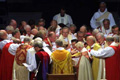
His elaborate, three-hour consecration ceremony was full of pageantry and tradition.
The Whittemore Center, a hockey and basketball arena at the University of New Hampshire in Durham, was converted into a makeshift cathedral "with an altar in the center of the floor, incense wafting through the bleachers, and a celebrant in a white cassock holding aloft a kite in the shape of a white dove, symbolizing the Holy Spirit," the Times said.
The procession of lay people and church leaders into the arena took 30 minutes. It included representatives from Episcopal schools and churches in New Hampshire, priests, and bishops wearing "festive stoles and their full episcopal finery," the newspaper said.
"Because of who you are, Gene, you will stand as a symbol of the unity of the church in a way in which none of the rest of us can," Theuner said in his sermon to the 4,000 people attending. Robinson listened intently, flanked by his former wife and two grown daughters as well as Mark Andrews, his gay partner of 14 years.
Robinson's supporters were jubilant, repeatedly breaking into long and enthusiastic ovations. He was pronounced a bishop after kneeling before a large group of bishops, including Presiding Bishop Frank T. Griswold, who laid hands on him in the centuries-old tradition. He received his miter as a gift from his daughters and Andrews.
In his first remarks as New Hampshire's bishop, his voice breaking, Robinson said, "You cannot imagine what an honor it is that you have called me." He reminded the audience that "there are people – faithful, wonderful, Christian people – for whom this is a moment of great pain, confusion and anger." The church must remain "hospitable, loving and caring to them in every way we can possibly muster," he said. "And if they must leave, they will always be welcomed back into our fellowship."
During the ceremony, an Albany, N.Y., bishop, a Pittsburgh priest, and a laywoman from rural New Hampshire offered respectful objections when the congregation was asked if there was "any reason why we should not proceed."
"It breaks my heart to be here," said the Rev. Earle Fox of Pittsburgh, before graphically describing sexual acts "engaged in by homosexuals." Griswold interrupted Fox, telling him to "spare us the details."
Assistant Bishop David Bena of Albany read a statement on behalf of three dozen bishops in the Episcopal Church and the Anglican Church of Canada, saying that members of his group and most bishops in the international Anglican Communion would not recognize Robinson as a bishop. "[Robinson's] chosen lifestyle is incompatible with Scripture and the teaching of this church," Bena said.
Meredith Harwood of Ashland, N.H., a 42-year-old mother of three, said: "We must not proceed with this terrible and unbiblical mistake, which will not only rupture the Anglican Communion, it will break God's heart." If Jesus were there, He would tell Robinson to "go and sin no more, just as He commanded the woman taken in adultery," Harwood said.
The protesters then lowered their heads and walked out of the ceremony with a half-dozen others. They made their way about a mile down the road to Durham Evangelical Church, where a few hundred Episcopalians gathered for an "alternative service" organized by the American Anglican Council, The Washington Post reported.
After the objections were raised, Griswold thanked attendees "for bringing their concerns before us" and told a story about a primate who told him that "the Holy Spirit can do different things in different places," adding, "That is precisely what we are doing here."
Conservatives said they are looking to the future.
"We stand at an incredible moment in history – a moment of profound new hope," the American Anglican Council said in its statement. "In the footsteps of those great church reformers of the past, it is now our time to boldly and unashamedly take a stand for righteousness. The cost may be high, but we must not be afraid. We must hold firm, confident in our salvation and not forgetting that the vast majority of Anglicans in the world stand with us. We are the mainstream, and the Episcopal Church has left us."


 Search:
 Subscribe:



 Email