WEEK OF SEPTEMBER 7, 2003
|
|
 |
|
|
|
 |

Alabama Chief Justice Roy Moore Is Caught Between
a Rock and a Hard Place
'Ten Commandments Judge' is under federal court orders to
remove granite monument.
Is Alabama Chief Justice Roy S. Moore a hero, or is he misguided? It depends on your point of view.
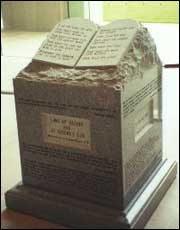
Moore is under pressure from a federal court order to remove a Ten Commandments monument he placed in the rotunda of Alabama's high court, in Montgomery. The large granite block must be gone by Aug. 20, the federal court said.
But Moore remains defiant, apparently ready to provoke a constitutional showdown between federal and state courts. "I have no intention of removing the monument of the Ten Commandments and the moral foundation of our law," he said at a press conference Aug. 14. "To do so would in effect be a disestablishment of the justice system of this state. This I cannot and will not do."
Rallies in support of Moore's position were planned for Aug. 16 and Aug. 20.
Moore first made headlines in the 1990s when, as a state court judge in Gadsen, Ala., he posted a hand-carved plaque of the Ten Commandments in his courtroom. He became known in the media as "the Ten Commandments judge."
The Alabama chapter of the American Civil Liberties Union and the state of Alabama sued Moore in 1995 over his actions. They lost, and Moore's status was raised to anti-federal-government folk hero. In 2000, Moore won a seat on the Alabama Supreme Court in a landslide popular vote. He said he viewed the margin as a mandate from the people to "restore the moral foundation of law."
The next year, Moore ordered that the 5,280-pound monument to the Ten Commandments be installed in the rotunda. The monument's sides bear quotations from the Declaration of Independence, the founders of the nation, the Pledge of Allegiance and the Preamble to the Alabama Constitution, as well as the national motto "In God We Trust."
But subsequently two federal courts have ruled that the monument must be removed. The U.S. Court of Appeals for the 11th Circuit in Atlanta ruled that the monument violates the First Amendment of the U.S. Constitution, which provides that "Congress shall make no law respecting an establishment of religion."
U.S. District Judge Myron H. Thompson has made it clear that he will hold the state in contempt of court if his order is not honored by Aug. 20. The monument is "nothing less than 'an obtrusive year-round religious display' ... to place the government's weight behind an obvious effort to proselytize on behalf of a particular religion," Thompson wrote in his opinion.
Moore is trying to persuade the U.S. Supreme Court to take up the case, but time is running out.
He has suggested that the federal courts lack the power to make him remove the display, claiming that doing so would be "a wrongful interference with state government." He says he believes the courts have misinterpreted the U.S. Constitution to forbid acknowledgment of God – an acknowledgment that he says Alabama's constitution requires.
"Anytime you deny the acknowledgement of God, you are undermining the entire basis for which our country exists," Moore told The New American. "Rights come from God, not from government. If government can give you rights, government can take them away from you. If God gives you rights, no man and no government can take them away from you."
Speakers at the Aug. 16 "Restore the Commandments" rally in Montgomery included conservative activist Alan Keyes, Southern Baptist minister and Liberty University Chancellor Jerry Falwell, and retired Gen. Raymond Davis.
"This modern-day Daniel is guilty only of openly practicing his faith in God," said Rick Scarborough, the former evangelist and pastor who is president of Vision America, the Texas-based activist group that organized the rally. The national advisory board of Vision America includes Falwell, Florida pastor D. James Kennedy, author Tim LaHaye, Tennessee pastor Adrian Rogers and American Family Association President Donald Wildmon.
Moore says he is not afraid of the consequences of refusing to remove the monument by the deadline. "If I go to jail, I go to jail," he said on a radio show, according to Agape Press. He also could be fined $5,000 a day, he said.
The Christian Coalition of Alabama is gathering signatures in an online petition to support Moore. The Mississippi-based American Family Association has started an online petition encouraging Congress to enact legislation that would remove federal jurisdiction in cases involving the Pledge of Allegiance, the national motto and public display of the Ten Commandments, instead leaving such decisions to the states. More than 120,000 people had signed that petition as of early last week, Buddy Smith of the AFA said.
"It seems like Judge Moore has thrown down the gauntlet," Smith told religionjournal.com. "I hope that what might come is a new recognition of the influence of God and God's Word upon this country and its laws." If the United States is "going to survive as a nation," not only do Americans have to recognize the importance of the Ten Commandments from a legal standpoint, but they also must "obey them and put them into practice in our everyday lives."
But some argue that the case is not about whether the state can acknowledge God. Displaying the Ten Commandments in a courthouse "does a lot more than that," The New York Times wrote in an editorial. "It promotes a particular theology as somehow linked to the justice dispensed by the Alabama judiciary, which is precisely what the First Amendment forbids government to do."
Moore is abusing his authority, critics say. "The federal courts are the guardians of Americans' constitutional liberties against state abuses, and state officials don't get to reject that role when it doesn't suit them," the Times said. "If Chief Justice Moore can decide which federal court opinions he likes, nobody's rights are safe from state officials who don't believe in them."
An editorial in the Montgomery Advertiser criticized Moore as "using the same arguments to defend ignoring the federal court order to remove the monument that Southern political racists used to defend ignoring federal court orders on civil rights four decades ago. The argument didn't work then, and in the long run, it's not likely to work now."
Joe Conn of Americans United For Separation of Church of State, a plaintiff in the lawsuit seeking the monument's removal, told The Associated Press that it is "disgraceful" that Moore has not already removed the monument. Moore "seems to think that the decisions of the federal courts are voluntary, that they're something that he doesn't have to obey."
Conn said Moore's actions remind him of George Wallace, the former Alabama governor who defied federal authority. "George Wallace tried to stand in the schoolhouse door to keep racial minorities out, thus exploiting race as a political issue," he said. "I think Judge Moore is standing in the courthouse door to keep religious minorities in their place – so he's doing the same thing that Governor Wallace did but with a different topic. I don't think it's going to work this time either."
In his interview with The New American, Moore said his opponents – including the Southern Poverty Law Center and the American Civil Liberties Union – also want to remove him as a judge.
He said that the groups "have objected to my behavior as a judge because I referenced the moral foundation of the law when we talked about sodomy, when we talked about adultery, when we talked about separation of church and state. I go back to the legal history that we have here in Alabama, our court case precedents, and the foundations of law to show that these things comport with the Scriptures from which we get our moral foundation."
Photo compliments of American Family Association.
|
|
|