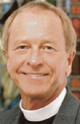
Joy and anger greeted the news last week that the Episcopal Church elected V. Gene Robinson, a noncelibate gay man, as bishop of New Hampshire. The vote by the Diocese of New Hampshire represents the first time an openly gay man has been picked as a bishop in the worldwide Anglican Communion, a global association of churches that trace their heritage to the Church of England. The 2.3 million-member Episcopal Church is part of the 79 million-member association, which also includes many conservative Anglican churches in Africa, Asia and Latin America.
Liberals in the United States hailed Robinson's election as a cause for celebration. "This is a breakthrough for which we've been waiting," Charles Bennison, bishop of Pennsylvania, told The Philadelphia Inquirer.
Conservatives were appalled. One called the vote "a rebellion against God's created order." The Diocese of New Hampshire "has severed itself from the Episcopal Church," said the Rev. David Moyer, president of the national traditionalist group Forward in Faith. If the General Convention allows the election to stand, Moyer warned, "the Episcopal Church will have severed itself from the Anglican Communion."
The Anglican Communion asserts that it bases its beliefs on scriptural principles contained in a document called the 39 Articles of Religion.
Robinson can be ordained as bishop only if he wins the consent of bishops and diocesan representatives at the General Convention, which will begin July 28 in Minneapolis. Many bishops in the more conservative South and Southwest, who will be among delegates to the General Convention, object to gay clergy. Conservatives say they will oppose Robinson's ratification at the meeting.
The election of Robinson is expected to speed up an exodus from the Episcopal Church, even among conservatives who have insisted that they want to remain to reform the denomination. Like many other mainline Protestant denominations, the Episcopal Church has been torn over the issue of homosexuality during the past 20 years.
James Solheim, the denomination's press officer, told The New York Times that reactions he received by e-mail indicate "some people are already announcing that this is the last straw, they're leaving the Episcopal Church."
Several conservative bishops had already stated privately that they would abandon the denomination if an openly gay bishop were elected, the publication Anglican Voice reported in 2000. "That is the line in the sand, which if crossed, would cause me to leave," one Southern bishop said.
A small but growing group of conservative laymen and priests has already left the church, forming 50 congregations that are part of the Anglican Mission in America. There have been legal battles as some congregations tried to leave the Episcopal Church and take church property with them (see religionjournal.com 06/08/03).
Church experts say that the Episcopal Church has had gay bishops before and does now, but none who have made their sexual orientation known before they were elected, according to the Times.
Robinson's supporters reacted to the vote with "foot-stomping in the pews, dancing in the aisles and a hug and a kiss for the winner from his partner" at St. Paul's Church in Concord, N.H., where the vote was taken June 7, The Daily Telegraph of London reported.
"When the tally was announced, the clergy and lay delegates leaped to their feet and applauded as Bishop-elect Robinson came to the front, stood before the altar rail and embraced his two grown daughters, his son-in-law and his partner," the Times reported.
Robinson, 56, urged the delegates who elected him to be "kind and sensitive and gentle" to believers who "will not understand what you've done here today."
Robinson divorced his wife, with whom he had two daughters, before moving in with his gay male partner, Mark Andrew, 13 years ago. "My partner has been with me in the rectory for 10 or 11 years. ... He is the one who served cookies and juice after the service in the rectory," Robinson said in a 2000 interview.
Robinson has said he left his wife in order to honor God. "My wife and I, in order to keep our wedding vow to 'honor each other in the name of God,' made the decision to let each other go," he wrote.
"I felt like I had been called by God to acknowledge who I am to my family, my church and my community," Robinson told the Inquirer. He and his former wife "returned to church, where our marriage had begun, and in the context of the Eucharist, released each other from our wedding vows, asked each other's forgiveness, cried a lot, pledged ourselves to the joint raising of our children and shared the body and blood of Christ."
Robinson has been trying for some time to be elected to high office in the Episcopal Church. In 1999 he was second in the election for bishop of Rochester, N.Y., and in 1998 he came in third in the contest to become bishop of Newark, N.J., according to news reports. He also considered, then rejected, a bid to become bishop of Vermont. His chances of success proved to be better in New Hampshire, where current Bishop Douglas Theuner, who is retiring after 17 years, has been an outspoken supporter of gay rights.
Anglicans worldwide are generally more conservative than American Episcopalians, and growth in the church in the developing world is tipping it toward theological conservatism on some issues.
Archbishop of Nigeria Peter Akinola, who heads the 15 million-member Church of Nigeria, said several years ago that "it would be an abomination for a sexually active gay man to be a bishop." Robinson responded to Akinola, saying that "my hope is that somehow we can keep coming to the communion rail together until we get it figured out."
The Church of England is officially opposed to the ordination of practicing homosexuals. In 1998, the Anglican Communion approved a resolution calling gay sex "incompatible with Scripture." Archbishop of Canterbury Rowan Williams is under intense pressure to keep the worldwide church from disintegrating, a "task that looks increasingly impossible," one observer said.
The election of Robinson follows outrage by conservative Anglican leaders over the first official ratification of a gay union by a Canadian bishop last month. Many leaders of national Anglican churches have declared that Bishop Michael Ingham and his Diocese of New Westminster, Canada, have broken communion with their churches.
Canada also moved a step closer to giving full marriage rights to homosexuals last week when a court in Ontario ordered that the definition of marriage as between "one man and one woman" be replaced by the term "two persons." The court's order directed the city clerk in Toronto to immediately issue marriage licenses to homosexual couples who had applied for them.
In 2001, the Netherlands became the first country in the world to legalize marriage for gays and lesbians.


 Search:
 Subscribe:



 Email