|
|
One Million, One Accord
A huge crowd proclaims
Christ in Mexico City.
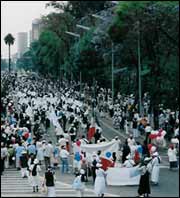
One million Christians marched through downtown Mexico City April 19. Their joyful celebration demonstrated the rapid growth of Pentecostal and charismatic churches in Mexico, a predominately Roman Catholic country.
Organizers called Marcha de Gloria, or March of Glory, the largest-ever gathering of Christians in Mexico. Pastors, ministry leaders and lay people from an estimated 20,000 congregations throughout the country participated. Alberto Sotres Hernandez, director of Mexico's Bible Union, said he agreed with the 1 million crowd estimate.
Marcha de Gloria stretched 10 miles along Reform Avenue, a main thoroughfare, and took three hours to complete. It featured a praise band, 400 dancers, and seas of colorful signs, banners and balloons.
The march culminated at the Zocalo, the main square, where the headquarters of the Roman Catholic Church and the National Palace are located. About 16 million people live in Mexico City, one of the world's largest metropolitan areas.
The march was broadcast live on 130 radio stations throughout the country. Afterward, participants held a huge, all-night Christian rally that featured music, prayer and preaching. The crowd spent the night praying, singing and listening to messages from speakers such as Alberto Mottesi, one of Latin America's best-known evangelists.
The all-night rally "rivaled the atmosphere of a Latin American championship soccer game" as people danced, raised their hands, and shouted 'Christ is alive,' " Charisma News Service reported. People came and went during the evening; Hernandez estimated that 50,000 were in attendance as the event ended at 7 a.m. on Easter morning.
"This is a historic day in Mexico," said the Rev. Carlos Quiroa, who organized the event. He is the pastor of Strong Tower Church, a charismatic congregation that meets in a hotel downtown. Quiroa's principal ministry is through radio programs, and "he has been quite successful in winning people to the Lord through them," Elisabeth Isais of Latin America Mission of Mexico told religionjournal.com.
FREE TO WORSHIP
A rally of this magnitude was impossible only a few years ago in Mexico, which once thought of itself as "the ultimate secular state," Ken MacHarg of Latin America Mission told religionjournal.com. Religious expression formerly was so restricted that Catholic priests were not allowed to wear clerical collars in public, he said.
Change has occurred gradually. Ten years ago, President Carlos Salinas de Gortari altered Mexico's constitution as it relates to religious expression, and that has "brought much more opportunity for public manifestations" of faith, Isais said. "Churches of all kinds are now operating openly and legally and can own property. In the past all church properties needed to be turned over to the government. Also, foreign missionaries are now able to obtain visas, something impossible in the past."
Christian radio stations are still not allowed, but Isais hopes that will change soon. "There are no Christian radio stations as such. They are not permitted by the government," she said. "Some secular stations carry Christian programs at certain times, and these programs are paid for at high prices. There may be some small stations in outlying parts of Mexico which are owned by Christians, but they are not allowed to operate as such.
"We are hoping and praying that this year the situation will change, since the government has tentatively promised to open the doors this year, but so far it has not happened. Of course, the Catholic Church is pressuring very hard to have the doors open for them to own stations, and we as evangelicals will also benefit from the new laws if they happen."
Mexico's culture is traditionally Catholic, but the religious landscape is much more complex than it seems, according to the Rev. Abner López of the Bible Society of Mexico. Evangelical and charismatic churches are growing rapidly, and Mexico's Catholics are in the midst of a renewal, he said.
"Today the Bible is considered an important book," López said. "Historically, however, the Bible was not especially important in the Catholic Church here. In recent years, the Catholic Church has begun to have Bible studies for lay people, and these have become very strong. We are making a great effort to work more with the Catholics."
At the same time, many traditionally Bible-centered evangelicals "seem to be losing interest in the Bible," he said. "The newer evangelical churches seem to focus more on worship, music and personal testimonies." Despite a shift away from biblical preaching, evangelical churches in Mexico still revere the Bible itself, he said.
Easter is the most widely celebrated religious holiday in Mexico. Observances occur in virtually every village, town and city beginning with Domingo de Ramos (Palm Sunday) and ending Domingo de Gloria (Easter Sunday). Every community has unique traditions for celebrating Semana Santa (Holy Week).
| Verse(s) for Teaching, Preaching and/or Discussion... |
| NIV |
As you come to him, the living Stone -- rejected by men but chosen by God and precious to him -- you also, like living stones, are being built into a spiritual house to be a holy priesthood, offering spiritual sacrifices acceptable to God through Jesus Christ.
Through Jesus, therefore, let us continually offer to God a sacrifice of praise -- the fruit of lips that confess his name. And do not forget to do good and to share with others, for with such sacrifices God is pleased.
Rejoice in the Lord always. I will say it again: Rejoice! Let your gentleness be evident to all. The Lord is near. |
I Peter 2:4-5
Hebrews 13:15-16
Philippians 4:4-5 |
|
| NAB |
Come to him, a living stone, rejected by human beings but chosen and precious in the sight of God, and, like living stones, let yourselves be built into a spiritual house to be a holy priesthood to offer spiritual sacrifices acceptable to God through Jesus Christ.
Through him (then) let us continually offer God a sacrifice of praise, that is, the fruit of lips that confess his name. Do not neglect to do good and to share what you have; God is pleased by sacrifices of that kind.
Rejoice in the Lord always. I shall say it again: rejoice! Your kindness should be known to all. The Lord is near. |
I Peter 2:4-5
Hebrews 13:15-16
Philippians 4:4-5 |
|
| KJV |
To whom coming, as unto a living stone, disallowed indeed of men, but chosen of God, and precious, Ye also, as lively stones, are built up a spiritual house, an holy priesthood, to offer up spiritual sacrifices, acceptable to God by Jesus Christ.
By him therefore let us offer the sacrifice of praise to God continually, that is, the fruit of our lips giving thanks to his name. But to do good and to communicate forget not: for with such sacrifices God is well pleased.
Rejoice in the Lord always: and again I say, Rejoice. Let your moderation be known unto all men. The Lord is at hand. |
I Peter 2:4-5
Hebrews 13:15-16
Philippians 4:4-5 |
|
| RSV |
Come to him, to that living stone, rejected by men but in God's sight chosen and precious; and like living stones be yourselves built into a spiritual house, to be a holy priesthood, to offer spiritual sacrifices acceptable to God through Jesus Christ.
Through him then let us continually offer up a sacrifice of praise to God, that is, the fruit of lips that acknowledge his name. Do not neglect to do good and to share what you have, for such sacrifices are pleasing to God.
Rejoice in the Lord always; again I will say, Rejoice. Let all men know your forbearance. The Lord is at hand.
|
I Peter 2:4-5
Hebrews 13:15-16
Philippians 4:4-5 |
|
|
|
|
|
|