|

SPONSOR NEWS CURRENT HEADLINES 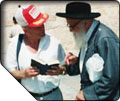
Jewish Group In Israel Persecutes At Will
By DAVID ROACH When help from law enforcement officials is sought, they refuse to get involved, thus giving tacit approval to religious persecution, Kalisher said. This scenario might be expected in countries like Sudan, Saudi Arabia or China. But Kalisher pastors a congregation in Israel, a nation thought by many Americans to be free from religious persecution. For Kalisher and the Jerusalem Assembly House of Redemption, the main source of persecution is a group known as Yad L'Achim (a Hebrew phrase meaning "Hand for the Brothers"). The congregation began two and a half years ago and has grown to about 250 in worship each weekend. Yad L'Achim, which operates from a combination of private and government funds, sees its mission as preserving the spiritual purity of the Jewish people by fending off the advance of Christianity, Kalisher said. Yad L'Achim believes that when Jewish people place their faith in Jesus Christ as Lord and Savior, they are effectively "killing the Jewish nation," Kalisher said. "It's taking the souls of the Jewish nation into idol worshiping. They believe that what we are doing is eliminating the Jewish seed. And they really feel ... that they are keeping the purity of the nation." Yad L'Achim views evangelistic efforts among Jewish people as tantamount to spiritual genocide and believes that Jewish evangelism must be stopped by any means necessary, Kalisher said. The views of Yad L'Achim are incorrect, he noted, because a Jewish person who studies the Old Testament should realize that Jesus is the culmination and the fulfillment of the Hebrew Scriptures. Rather than killing Jewish religion, belief in Christ takes Jewish faith to its logical extension, he said. "To believe in Christ Jesus is really to behave like a biblical Jew," Kalisher said. "Not to believe in Jesus as Savior is admitting that you really did not study the Law and you didn't really understand it.... If you are really a Jew in your heart and study the Word of God, you're supposed to run to Jesus." Neverthless, Yad L'Achim activists "will come and demonstrate next to your home," Kalisher said. "They will put pressure at your work against you. They will speak with your neighbors and distort your testimony to make it seem as if you are a bad or dirty person. If you go to do something for the Lord [even if it is in accordance with Israeli law], they will be there to bother you or do something physically to destroy your material." Although Messianic believers have attempted to ask law enforcement officials for help, Yad L'Achim enjoys cooperation from many government officials, Kalisher said. "They have contact in all types of government offices," he said. "There is not a law in Israel against us. But this group sometimes does things regardless of what the law says, knowing that although the law is not with them, the people who are supposed to enforce the law have the same mindset as them. They are doing things that people are supposed to go to jail for. And basically, the police will not even bother themselves to discover or to search or to find them or even to call them to tell them to stop what they are doing," Kalisher said. Kalisher's congregation felt the effects of government cooperation with Yad L'Achim when, for example, anti-Christian forces threatened to revoke the kosher food license of a kibbutz from which the Jerusalem Assembly had been renting space, he said. Because no business can survive in Israel without serving kosher food, the kibbutz forced the congregation to find an alternate meeting place, the pastor said. Another way in which government cooperates with Yad L'Achim is by refusing to prosecute those who destroy the church's promotional materials, Kalisher said. "Whenever we buy or rent a billboard from the municipality, they will send people with spray-paint, and they will spray it all over although we have a license to put it up," Kalisher said. "If you do that, you should go to jail for three months. That's the law. But they do it on a regular basis, and we really have no one even to call. The police will hear that and basically look at us like we are stupid to have called them." Israeli politicians rarely lend assistance to persecuted believers because to do so would represent political suicide, Kalisher said. "If you should do that [assist persecuted believers], you would be dead politically," he said. "... A politician won't take flack just to help believers. They say, 'Come on. The Messiah hasn't come yet.'" Despite the persecution felt by Kalisher and other Messianic believers, he noted that the Israeli government generally protects freedom of religion. "We really enjoy freedom of faith [in Israel]," he said. "As a citizen, I enjoy that I can say that I'm a believer. I thank God that I'm living in Israel. My problem is people who do not give us the rights that the law grants us.... We do enjoy good democracy and freedom of faith." Kalisher also noted that many Southern Baptists have contributed to religious freedom in Israel by supporting the democratic policies of the Israeli government. "The Southern Baptists that I know are very, very pro-Israel and would do anything in their ability to promote evangelistic projects here and promote the peace of Israel," he said. "... I see their love of Israel in the way they minister and work." American Christians can take several actions to help persecuted Jewish believers in Israel, Kalisher said. "If all the born-again, believing churches were focused on this area in prayer, I believe it would be magnificent," Kalisher said. "Sometimes I'm amazed that Christian groups ... will donate money to build synagogues," Kalisher said. "I really ... cannot understand that. I'm not saying they should hate these [Jewish] people. They should pray for them to be saved. But their spiritual brothers need to be supported. And sometimes their support is being given without really examining where it goes." Ultimately, the persecution Messianic believers face in Israel is a matter of spiritual warfare more than it is a matter of earthly forces, Kalisher said. The fundamental reason Christians are persecuted is that the Gospel offends those whose hearts are hardened against the Lord, he said. "Because we put the cross straightforwardly, we are persecuted," he said. "It is a spiritual war, and we are being persecuted because we love the Lord and we share the Gospel. And they don't like us. If we would be quiet and not speak, they would be friends with us." The report states that 84 people died in religious clashes in Kano in 2004. Methodist Bishop Foster Ekeleme, chairman of the Kano chapter of the Christian Association of Nigeria, places the casualty count at nearly 3,000 Christian dead. "Let us not continue to argue about numbers," Ekeleme said. "Why should even one Christian be killed?" Religious violence in Kano was provoked by earlier clashes in the town of Yelwa, Plateau state. Those incidents claimed an estimated 350 lives. Meanwhile, intelligence forces have uncovered plans by Muslim militants in Kano to attack Christians and burn down churches in order to destabilize the government and force the observance of Islamic law. [by Obed Minchakpu] Judicial Magistrate Dr. Mohammed Anwar Gondal ruled on Dec. 17 that the accusations against Masih were based only on hearsay evidence and that the police report filed against Masih was nullified because it violated the criminal procedure code. Masih, now 32, was arrested on Nov. 30, 2003. A neighbor who had converted from Christianity to Islam claimed that Masih had mocked his new beard and derided Islamic beliefs. Although cleared of blasphemy charges, Masih remains in hiding, unable to be reunited with his wife and four children because extremists from the Islamic Religious Army have vowed to kill him. He joins more than a dozen other Pakistani Christians who, despite their innocence, have been forced to apply for asylum abroad to live under new identities. Police inexplicably entered the building and took the entire wedding party to jail, where they remain under arrest. The arrest marked the first reported crackdown against Eritrea's Catholic community, which enjoys "official" recognition by the government, along with Orthodox and Lutheran Christians and Muslims. On the same Sunday morning, security police swooped down on a wedding ceremony in Barentu and arrested the 67 evangelical Christians present. All the prisoners -- among them a number of elderly people and young children -- reportedly were to be taken to the Sawa Military Training Center for "military punishment." Meanwhile, Compass has confirmed that 25 of the 60 Rema Charismatic Church members arrested at a New Year's Eve celebration in Asmara have been released after signing a pledge not to participate in such meetings again. Father Francisco Montoya, 33, was kidnapped Dec. 8 while traveling from Quibdó, Chocó, to the village of Nóvita, about 400 miles northeast of Bogota. "He had entered the area without their authorization. They accused him of being an army informant," said Manuel García, Vicar General of the Quibdó diocese. Marxist guerrillas and right-wing paramilitaries control large swaths of territory in the embattled Chocó department (state), terrorizing local residents and trafficking in narcotics. Guerrilla spokesmen said they buried Montoya on the mountain where he was murdered, but refused to allow his remains to be exhumed, citing security concerns. "The church can enter, but only with their [FARC] authorization," García said. "It's a very painful situation." Hossam Armanious (47), his wife Amal Garas (36), and their daughters Sylvia (15) and Monica (8) were found in their house in Jersey City, bound and gagged with their throats slit and knife wounds to their heads and bodies. While police are suggesting a robbery as the possible motive, the style of killing has made friends and relatives see a link with Islamic teaching on killing unbelievers. Armanious and his family moved from Luxor, Upper Egypt to the USA in late 1990s to escape the growing anti-Christian violence in Upper Egypt. Such violence has seen many Christians killed and much Christian property destroyed in recent years. As a devout Christian, Armanious was outspoken about his faith, and continued to publicize the persecution of Christians in Egypt that had caused them to flee. He was known to have frequent vigorous debates on religion, including criticising Islam, in internet chat rooms. Two months ago he received the threat that if he didn't stop these comments 'we are going to track you down like a chicken and kill you'. A parishioner of St. George and St. Shenouda, the Coptic Orthodox church they attended, said, 'They are trying to make us afraid, make us keep our mouth shut.' Armanious' refusal to keep quiet about Christian persecution under Islam may finally have caused the fatal stabbings. Sylvia, who her friends described as 'very religious and very opinionated', seemed to family members to have taken more savage wounds than the others. She had a large gash across her chest and also stab wounds on her wrist. Though the slash on her wrist was near her tattoo of the Coptic cross, which all the family had, police have stated that it looks more like a defensive wound than an attempt to cut the tattoo. These tragic deaths seem as if they may be part of a growing trend by Islamic militants to kill -- often by slitting the throat -- those whom they see as a threat, including those who address the issue of persecution of non-Muslims within the Islamic tradition. "The Baptists are just twelve families and the villagers say they already have one church," he told Forum 18 News Service from Gurjaani on Jan. 13, referring to the local Orthodox church. "But it isn't true to say the Baptists can't build non-Orthodox places of worship." Local Baptists reject his assurances, in comments echoed by believers of many minority faiths across Georgia, who currently have no right to build new places of worship. In a separate case, on Dec. 28, unknown attackers smashed windows of a house in the village of Kuchatani in Kvareli [Qvareli] district used as a church for local Baptists, the latest in a series of attacks on the house, Pastor Levan Akhalmosulishvili, a leading member of the independent Association of Christian-Baptist Churches, told Forum 18. The house had not long been repaired after attacks in October. These latest incidents come as the trial continues of a handful of the most notorious of those responsible for the five-year reign of terror against religious minorities by self-appointed and self-declared Orthodox vigilantes between 1999 and 2003. Old Calendarist Orthodox priest Fr. Basil Mkalavishvili and six associates are on trial in a court in the capital Tbilisi, but hundreds more individuals who organized and took part in the wave of violence -- which religious minorities say included clerics of the Georgian Orthodox Patriarchate -- have never been prosecuted.
|


 Search:
 Subscribe:
|
Contact Us:
 Email or Voice: 864-848-4700 religionjournal.com is a free service supported by generous donations from our readers. Contributions are tax-deductible and greatly appreciated. |