(LifeSiteNews.com) In the wake of controversy surrounding a presidential candidate questionnaire produced by the lay staff of the United States Conference of Catholic Bishops, many Catholics have embraced an alternative voting guide issued by a Catholic apologetics organization. Though the USCCB has discouraged use of this new guide, it has been circulated by at least one major archdiocese and thousands of parishes, according to the publisher.
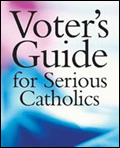
"Voter's Guide for Serious Catholics" is a 10-page booklet produced by Catholic Answers, a lay apostolate based in San Diego whose primary mission is defending Catholic teaching. Citing papal and Vatican documents, "Voter's Guide" identifies five issues it calls "non-negotiable": abortion, euthanasia, fetal stem cell research, human cloning and homosexual "marriage." Supporting any of these issues, according to the guide, would disqualify a candidate as a viable option for a faithful Catholic.
Frank Norris, Catholic Answers Director of Development, told Culture & Cosmos that the guide has been very successful, citing more than a million in distribution. Norris estimates that by election day in November Catholic Answers will have distributed somewhere between 2 million to 5 million copies. Norris said the guide is being distributed by the St. Louis Archdiocese and that two more dioceses are considering distributing it. He went on to say that more than one thousand individuals have requested copies of the guide. Norris also said the booklet may soon receive an imprimatur from the bishop of San Diego [an imprimatur is official guidance from a bishop that the information is free from doctrinal error]. Even so, the booklet has faced resistance and even disapproval from the legal staff of the USCCB.
(RNS) In what could be a landmark case in church property disputes, a California court has ruled that a breakaway Fresno congregation may keep its property after it decided to sever ties with the United Methodist Church.
The decision by the 5th District Court of Appeal to award St. Luke's Community Church custody over its building runs against most property dispute cases. Courts typically rule that local parishes do not own their property because they are held "in trust" for the denomination.
Two years ago, a lower court ruled in favor of the denomination. "We agree with the earlier decision -- that's our position," Bishop Beverly Shamana told the Fresno Bee. "The courts did what they felt they needed to do. We are considering our options."
Attorneys for the denomination are mulling an appeal to the California State Court. The church's new pastor, the Rev. Kevin Smith, hopes they do not push the case. "Enough money has been spent in this case already," he said.
In 2000, St. Luke's voted to leave the denomination after its liberal-leaning local conference declined to press charges against clergy who performed same-sex union ceremonies. St. Luke's leaders accused the church of ignoring its own constitution.
St. Luke's leaders said they had the right to alter the church's incorporation documents. "We agree with St. Luke's contention that it could and in fact did revoke the trust which had existed in favor of the United Methodist Church," the court ruled.
Shamana argued properties are held in trust to ensure that the denomination has a presence in local areas. "We are living in stress-filled times and the United Methodist Church ... is a spiritual presence we want to see maintained in the Fresno community," she said in a statement.
Bob Shannon, an attorney for the church's California-Nevada Conference, said the decision "is very disruptive to how the United Methodist Church works generally" and said an appeal is "very likely." [By Kevin Eckstrom]
(LifeSiteNews.com) Two more Episcopal parishes have cut all ties to the U.S. national Episcopal church, criticizing the move by the national assembly to approve the election of openly homosexual Gene Robinson as bishop of New Hampshire.
All Saints Church in Long Beach and St. James Parish in Newport Beach have announced a decision to place themselves under the authority of a conservative Anglican bishop from Africa.
The two California churches, along with as many as 100 other concerned parishes in the U.S., also decry the U.S. General Convention's decision to authorize local bishops to solemnize same-sex unions.
Following the Convention's controversial decisions, parishioner's of All Saints repeatedly said, "This is bad! We must go," according to rector Rev. William Thompson, as reported by boston.com news.
Los Angeles Episcopal Bishop J. Jon Bruno, who said he has no plans to surrender his authority over the area churches, also incurred criticism when he officiated at the same-sex ceremony of one of his priests, Rev. Canon Malcolm Boyd, and his male partner.
The U.S. Episcopal congregation has 2.3-million members; there are 77 million Anglicans world-wide.
(Agape PressArchbishop Henry Luke Orombi, the Anglican primate of Uganda, has declared his full support for the two Southern California parishes that broke away from the American branch of the Anglican Communion over the denomination's stand on homosexuality. On Monday, August 23, Archbishop Orombi announced his support for these dissenting congregations and denounced Los Angeles Episcopal Bishop J. Jon Bruno because of his threat to defrock the clergy of the disaffected parishes unless they returned to the ECUSA.
The Ugandan archbishop's intervention raises the dispute to the level of a controversy between two national churches. He has condemned any attempt on the part of the Los Angeles bishop to depose the dissident priests and claims "he has no jurisdiction over them, and his actions will not be recognized."
Bruno responded to Orombi's statement by saying he would not yield his authority over the breakaway clergy. Orombi's Ugandan province broke relations with the ECUSA last year after the U.S. church approved the election of homosexual priest V. Gene Robinson as bishop of the Diocese of New Hampshire. [By Jenni Parker]
(RNS) In a bid to learn who has undisclosed plans to sue, the Catholic Archdiocese of Portland has proposed a Dec. 31, 2004, deadline for victims of sexual abuse to name themselves and provide details of their ordeals. In papers filed Thursday in U.S. Bankruptcy Court, the archdiocese proposed a two-page "tort proof of claim" form. The archdiocese also outlined a plan to advertise the deadline in regional and national news media.
A church official and a lawyer characterized it as a necessary step to move the bankruptcy proceedings forward. Lawyers for victims roundly condemned the proposed form and media campaign as insensitive.
The archdiocese sought Chapter 11 bankruptcy protection last month in an effort to shield some of its assets from dozens of lawsuits that have already been filed. It is the first Catholic diocese to file for bankruptcy because of clergy abuse claims, and the Portland case is being closely watched nationwide.
The norm in bankruptcy proceedings is to compile a list of those with claims against the debtor. But in many situations, the claims are not as emotionally sensitive as those involving sexual abuse. The proposed form asks for a claimant's name and address, dates and places of the abuse, the name of the abuser, descriptions of the abuse and the total amount of money the claimant seeks. It also seeks names of witnesses, confidants, therapists and lawyers.
"It is clearly intimidating," said David Slader, an attorney who has represented dozens of priest abuse plaintiffs. "Most abuse survivors are ultimately willing to publicly disclose their names, but that's a gradual process. To expect someone to suddenly put their name on the form, and all the details of their abuse, is absurd," he said. "There is no question that this is a very intimidating process that very few survivors are likely to take advantage of. No doubt that played a part in the calculation of the archdiocese, in designing the form the way they have."
Bud Bunce, communications director for the archdiocese, said the archdiocese "is trying to find all other possible claims that might be against the church." The proposed form is a working document, he said, one that will be adjusted after consultations with other attorneys in the bankruptcy proceeding. It must be approved by Bankruptcy Judge Elizabeth Perris. [By Nancy Haught and Jeff Manning]
(LifeSiteNews.com) It is becoming more and more obvious that the the Catholic Church hierarchy is divided over fundamental moral issues. This week, Barbara Kralis published another article on the Catholic World News website including interviews with three U.S. bishops in which they mince no words in their criticism of retired Chicago sociologist and novelist, Fr. Andrew Greeley.
Since the U.S. bishops met in Dallas to decide what action to take on the problem of Catholic politicians who support abortion, Fr. Greeley wrote in an article in the New York Daily News that a Catholic may vote for a pro-abortion politician as long as he makes a "mental reservation" and is supporting him for reasons that have nothing to do with the candidate's support of abortion. Greeley went on to criticize the bishops who have spoken up in defense of the Catholic Church's teaching saying that they had little knowledge of 'traditional' Catholic moral theology.
Kralis confirms that Greeley, because of his outspoken dissent from Catholic teaching, is the "darling of the secular media," especially on issues related to ordination of women and sexual morality.
Three bishops have come forward and have denounced Fr. Greeley in strong terms in interviews with Kralis:
Robert Francis Vasa of Baker, Oregon said that the theological debate over when a Catholic may vote for a pro-abortion politician is beside the point. He said, "Whether he should or should not, in my mind, is very clear. Pre-born human life in our country is under consistent and vicious attack and those lives must be defended. As I have said elsewhere, these little ones have no vote but mine and I will use it for them at every opportunity."
Bishop Michael J. Sheridan of Colorado Springs said, "How do we balance out the murder of more than one million babies each year with any good or series of goods?"
But it was Bishop Fabian Bruskewitz of Lincoln, Nebraska who had the strongest terms for Fr. Greeley calling him a "superficial writer" and one from whom no Catholic of sense would take pastoral advice. He berates Greeley for his 'tragic indifference' to abortion.
"In his self-important buffoonery, he has appointed himself as instructor to Bishops and to Catholics nationwide. In doing this, he merely announces to every thoughtful Catholic that his views are totally self serving and undeserving of any serious consideration," said Bruskewitz.
(LifeSiteNews.com) The heads of U.S. Catholic religious orders, meeting August 21 at the Forth Worth Convention Center, sent a message of defiance to American bishops and the Vatican. The theme of the conference was "No Longer Bystanders: Creating Peace in Violent Times".
The heads of religious orders belonged to the Leadership Conference of Women Religious (LCWR) and the Conference of Major Superiors of Men (CMSM). CMSM represents 20,000 priests and brothers belonging to male religious orders, and LCWR represents 74,000 Catholic nuns in the United States.
During the meeting, little mention was made of men and women religious' potential role in mitigating violence by fostering the culture of life and respect in society. There was virtually no mention of abuse scandals within religious orders, which victims protested earlier in the week.
Instead, the leaders of religious orders took aim at the Pope and bishops, using violence rhetoric to describe the Catholic Church's policies. The Rev. Michael Crosby of Milwaukee bemoaned what he called "the controlling power of the clergy" and called the Church's unwillingness to compromise its doctrine a "sinful, structural and systemic violence." Among the instances of violence cited by participants was the movement by bishops to refuse Holy Communion to pro-abortion politicians and their supporters.
Both organizations are marked by antagonism toward the hierarchy and Church teachings and their emphasis on political activism in a secular humanist context.


 Search:
 Subscribe:



 Email or