(RNS) As Florida recovers from the wrath of Hurricane Charley, some churches are coping with destroyed or seriously damaged property and other religious groups have begun relief efforts to help the state's residents.
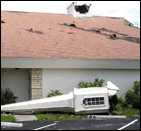
The Church of the Nazarene reported that a church in Punta Gorda was a total loss and the steeple of another in nearby Port Charlotte was broken off by strong winds in the storm that hit the state Friday (Aug. 13). "It was scary and we are thankful to still be alive and well," said Pastor John Denby of the Punta Gorda Church of the Nazarene, who stayed at the church building during the storm.
A Southern Baptist church and a Presbyterian Church (USA) congregation in Punta Gorda also were destroyed, as well as a Presbyterian church on Sanibel Island, denominational news services reported.
Numerous faith-based relief organizations have begun to deliver supplies to the multitudes of Floridians who have suffered property damage and loss of power. "You give them some water and it's like you gave them a bar of gold," said Steve Ewing, an on-site representative of Convoy of Hope, a relief organization working with the Assemblies of God. That denomination's news service reported that a church in Punta Gorda was a total loss while others sustained hundreds of thousands of dollars of damage.
Other religious organizations, such as Catholic Charities USA, the Florida District of the Unitarian Universalist Association and the Cooperative Baptist Fellowship, have begun soliciting donations to help victims of the hurricane. Groups like the United Methodist Committee on Relief, the Southern Baptist Convention Disaster Relief and the Church of Jesus Christ of Latter-day Saints' Church Welfare Services have shipped flood buckets, assigned food units and provided emergency supplies.
Catholic Relief Services is working with its partner Caritas Cubana to help those affected by the hurricane that crossed western Cuba before heading to the United States.
The Associated Press reported that Charley resulted in 19 deaths in Florida, four in Cuba and one in Jamaica.
ADDITIONAL HURRICANE CHARLEY REPORTS
Assemblies of God The A/G Convoy of Hope has provided 16 truckloads (over 720,000 lbs.) of water, food and cleaning supplies. FEMA has been utilizing COH extensively for local distribution and has requested that COH set up a second distribution site.
Convoy was the first relief organization in Punta Gorda, Florida. Team members said it was like a scene from a movie – people walking around with heads in hands. They distributed water and supplies to thousands of people, listened to their heart-rending stories, and prayed with those who had lost almost everything they owned.
The greatest need continues to be water and ice. While the water system is out of service in Punta Gorda, trucks are shuttling back and forth to North Carolina to collect more water.
On August 22, 2004, A/G Sunday school students will be asked to take an offering to help with Florida recovery efforts. All of the funds collected will go directly to Disaster Relief of the Assemblies of God.
Baptist Southern Baptist disaster relief efforts continue to build with nearly 100 cleanup and recovery teams activated, representing more than a dozen Baptist state conventions, according to denomination reports.
Mickey Caison, manager of the Disaster Operations Center at the North American Mission Board, said that as of early afternoon, Aug. 17, Southern Baptist disaster relief volunteers had prepared more than 30,000 meals.
Nearly 800 Southern Baptist volunteers from across the country were participating in more than 350 disaster relief projects throughout southwest Florida in the wake of Hurricane Charley.
Baptist state conventions in Georgia, Kentucky, Missouri, North Carolina, Texas, and Virginia sent shower units, mobile kitchens and chainsaw & recovery teams, Aug. 17, for assignment to Florida sites including Orlando, Ft. Myers, Bartow, and Punta Gorda.
Catholic Catholic Relief Services donated $70,000 to local partner Caritas Cubana for relief efforts in the wake of destruction caused by Hurricane Charley. Cuban government officials are calling the storm the most destructive to hit Havana since 1915.
Hurricane Charley was a Category 2 storm when it hit the provinces of Havana and Pinar del Rio, downing trees and power lines, damaging thousands of homes and forcing 36,000 people into public shelters. Damage assessments are still ongoing, but reports indicate 95 percent of sugarcane, bean and banana crops have been seriously affected in the two provinces. More than 500 schools and nearly two dozen health centers were also damaged by wind gusts that topped 100 mph.
Catholic Relief Services is the official international humanitarian agency of the U.S. Catholic community.
CBN CBN's Operation Blessing International, a religious humanitarian organization affiliated with the Christian Broadcast Network, is providing food and disaster relief supplies from their warehouse, as well as transportation services of supplies and equipment requiring tractor-trailers through the utilization of the Hunger Strike Force, which is the food and relief supply distribution arm of OBI.
Church of God Before Charley made landfall, Operation Compassion mobilized disaster sites and relief centers near the hurricane. As soon as the storm cleared, disaster relief supplies made their way to residents suffering from the destruction of the storm.
Lutheran The Evangelical Lutheran Church in America's Domestic Disaster Response and Lutheran Disaster Response are working with emergency management authorities and ecumenical partners in recovery efforts north of Fort Myers and Port Charlotte, Punta Gorda and inland toward Orlando, Fla. Both are providing crisis counseling and spiritual support for survivors of Hurricane Charley.
Some congregations of the ELCA -- Holy Trinity Lutheran Church and Peace Lutheran Church, both in Port Charlotte -- sustained significant damage (see photo).
Methodist UMCOR shipped all available flood buckets to Florida from its Sager Brown Depot in Louisiana. Partnering with the agency on providing flood cleanup supplies were Mercy Center in North Carolina, Midwest Distribution Center, Illinois, and Mission Central, Pennsylvania.
F. Thomas Hazelwood, UMCOR's director of emergency services, was scheduled to meet with church-related disaster coordinators and assist with assessment of relief needs. Members of the United Methodist Florida Annual (regional) Conference also met in Orlando to begin formulating a response.
The members of the conference disaster response team will be meeting people's needs from Fort Myers to Daytona Beach and along the state's I-4 corridor, according to the e-Review.
President George Bush, a United Methodist, toured devastated areas by helicopter on Aug. 15 and provided comfort to Punta Gorda residents.
Churches have been assisting in relief efforts by delivering food house-to-house and by arranging crews to help tarp roofs so that people will be dry. One UM church delivered more than 1,000 meals to people on Aug. 15, according the denomination.
UMCOR is asking United Methodists to help replenish its supply of flood buckets in what is now the beginning of hurricane season. Completed flood buckets should be sent to UMCOR Sager Brown, 101 Sager Brown Rd., Baldwin, LA 70514.
Salvation Army The Salvation Army built a State Disaster Command Center four years ago at 930 East 139th Avenue in northeast Tampa off of Nebraska Avenue. It is serving as a command center to coordinate Salvation Army's relief efforts throughout the state, and as a distribution point for the warehousing and distribution of relief supplies to those affected by the storm.
The warehouse was stacked with rows and rows of water, cleaning supplies, paper products and other disaster related equipment such as generators, cots, and tents. It has an extensive fleet of disaster response vehicles, including mass feeding units that can prepare and feed 5,000 meals, shower and sleeping units, refrigeration trucks and mobile command centers that can be set up at local disaster locations.
The Salvation Army mobile canteen is enabling The Salvation Army to go to affected areas and provide hot meals and other disaster related services on the scene. Manned by two people, the units are self-contained and can cook hot meals all day if necessary.


 Search:
 Subscribe:

 Email or