The Mongolian church is young but growing fast since the fall of communism 14 years ago, according to a new report by The Sentinel Group. An explosion of people who have become Christians has pushed the number from 20,000 last year to 35,000 this year.
Landlocked between China and Siberia, the semi-desert nation of Mongolia is slightly smaller than Alaska, and is predominately Tibetan Buddhist. Situated on the Tuul River and surrounded by the foothills of the Khangai mountain range, the capital, Ulan Bator ("Red Hero") prospered on the tea route between Russia and China. In the 13th century Mongols under Genghis Khan conquered a huge Eurasian empire, but eventually retreated to the steppes and came under China's rule. In 1921 Mongolia won its independence with the help of the Soviet Union. A communist regime which took over in 1924 was rejected in 1996, and doors began to open for the Gospel.
There is a "passion for God beyond what I see in the North American Church," said Alistair Petrie of Partnership Ministries in Abbotsford, B. C., Canada, who recently visited Mongolia. Petrie was on a team that led a national prayer initiative in Ulan Bator, Mongolia from March 19-24, 2004. The late winter weather was frigid, but the atmosphere fervent as 200 leaders from 115 churches around Mongolia met together for united prayer.
Protracted times of prayer took place at the meetings. Delegates prayed that the power of false gods and deceiving spirits would be driven out of the land. Along with the growth of the Christian church have come inroads by cults, including a revival of Tibetan Buddhism, and the worship of Genghis Khan.
Many of the young leaders of the Mongolian Church became Christians after becoming disenchanted with Buddhism. Some were converted after reading the Bible, others through 'supernatural visitations.' Some were introduced to the Gospel by Christian agencies, such as World Vision, who often employ non-Christian workers.
Mongolians "have understood spiritual issues for a long time, and realize the supernatural as significant," Petrie says. "They see Christianity as a supernatural empowering of God."
Many of the church leaders in Mongolia have only had a basic ministry training. Some are coming to the United States for further training, including institutions such as Fuller Seminary, which has given grants to young Mongolian Christian leaders.
The Transformations video greatly impacted the nation of Mongolia. "It was a catalyst, and was seen in many, many churches," Petrie said. And the prayer movement was "fueled into high fervor" as a result.
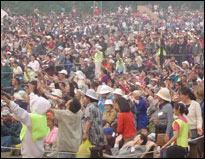
Large crusades have also taken place in Ulan Bator. Charles Ndifon, of the New England-based Christ Love Ministries International, held a crusade in the city in June 2003, organized by HELP International and ten local churches. The Nigerian born evangelist reported thousands were 'saved, healed and delivered.'
Today there are growing prayer networks all across the country. "They are diligent prayer people," says Petrie. In fact, Mongolian Christians see China as their "next door mission field." Petrie says Mongolians are not restricted from going into China. They have taken ministry journeys into China, working with the Three-Self Church and the underground church, and they plan to do more.


 Search:
 Subscribe:



 Email or