by Michael Ireland Chief Correspondent, ASSIST News Service
"This trip was one of the most exciting trips of the last several years in terms of ministry opportunities and accomplishments," said Sergey Rakhuba, Vice President of Russian Ministries, based in Wheaton, Illinois, on his return from Russia, Ukraine and Belarus.
"As you probably know, we are working to mobilize, train and equip young Christian leaders in Russia for more active outreach in the church.
"In light of this renewed ministry strategy, we traveled with our national team to some of the most remote parts of Arctic Siberia as part of a national evangelistic expedition that Russian evangelicals launched to cover 11 time zones of Russia. The leaders of this tour were our national missionaries that we trained and equipped for last decade and who now train and disciple young people for ministry in places where the gospel has never been preached before. I was so excited to participate in this mission expedition," Rakhuba said in an e-mail circulated to supporters of his ministry.
"Locals in the city of Salekhard say that this is the only city in the world that splits the Arctic Circle. Anatoly, our young and gifted church leader was one of the first Christians in the area. He took our group to the construction site of a new church and ministry center. A construction crew was drilling foundational pillars through 40-foot permafrost. It was 40 F below zero, not considering wind-chill.
"As we stood there, Anatoly shared a shocking story. The newly-launched church looked for a place to build, and found only one place. After actual construction started, they discovered that their church would be on the same site where Stalin's local Gulag office had stood. Tens of thousands of our brothers and sisters likely came through that office and never got back to their homes. Today the foundation of that new church is literally resting on the bones and innocent tears of those Russian believers."
Rakhuba stood by the construction site watching the crew eagerly carrying heavy logs and putting them in place.
"I thought of many of my fellow brothers who suffered in that place. Surely they never dreamed that on the same spot where they endured torture, an evangelical church would be built 65 years later. What a monument to their faithfulness in God's power and glory! We joined Anatoly in prayer asking God again to reveal himself in a miracle of a newly-built church and a training center, an outpost for expansion of His kingdom to the frozen ends of the Russian Arctic. I thanked God for the young Christian leaders that He is raising up there to bring the gospel to those who have never heard it before. I also thought about telling this story of great encouragement to good friends like you who faithfully support our ministry."
Another day Rakhuba and his team drove about 150 kilometers to the little village of Beloyarsk.
"On the way to this little town of about 3,000 people we got stuck several times in a 'zimnik,' a snow-packed road that is available only in winter and only for four- or six-wheel drive trucks.
"We could not travel further on the expedition's Toyota Land Cruisers and had to reload all the Bibles and Christmas presents on fully-tracked troop carriers that are used for civilian purposes in a road-less environment. We worked with Nentsy (native) believers and gave a great presentation for children that came to a local "internat" (a boarding school/orphanage for children of reindeer herders). After telling them the story of Jesus, we gave them all shoebox gifts(Christmas presents), that were generously donated by Samaritan's Purse, and children's Bibles that are popular among children and adults," Rakhuba said.
"We traveled on through deep snow-packed tundra driving even farther north. After a time, it was hard to believe that we would ever find any other humans." Finally, "we came to Schuchie, a little village of about 350 families."
There are two significant things about the village of Schuchie, Rakhuba said.
"First, this place exists in deep isolation from the mainland by miles and miles of tundra. In the summer it is only accessible by flat-bottom boat and it takes 8-9 hours to reach the nearest village. In winter, on a snowmobile or reindeer sled, it takes about 14-15 hours. Second, the gospel was never presented to the people that live there. We were the first to tell the people of this village about Jesus.
"I was very moved by the sight of a reindeer herder's kids dressed in a heavy handmade reindeer skins, reaching out their hands to get a 'box of love' perhaps even packed by some of you. Anatoly explained that these gifts symbolize the Gift of all gifts. Now they know that Jesus, the Son of God, paid their debts. To be the first to tell these people about the only true God was a deep and wonderful privilege."
After returning from Siberia to Moscow, Rakhuba visited Belarus and Ukraine to discuss ministry with church leaders and national teams.
"There is still tremendous opportunity to expand national church growth through our newly-designed program to mobilize, equip and train Next Generation church leaders. This is a key strategy, not just for the Russian Ministries team, but for many other groups as well. We work on this new strategy and have utmost respect for older, established, church leaders in the former Soviet Union. We respect their faithfulness and give them great credit even as we look forward to the future. (2Tim. 2-2)."
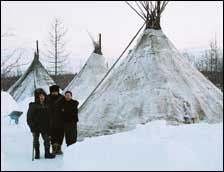
(The story and photo don't tell the full story. Of the 2,900 kilometers they traveled, 800 were driven on dangerous snow-packed tundra roads, 160 kilometers were on sleds pulled by snowmobiles to the teepee settlements, and 160 kilometers were in full-track staff carriers. Plus, they held 27 evangelistic outreach services in 16 different villages and towns. About 4,000 people in Yamal heard the gospel; 2,500 children's Bibles were distributed to kids and families; 2,000 gospel tracks were distributed to ethnic tribal people in their own language; and 500 gift boxes were donated by the Samaritan's Purse.)


 Search:
 Subscribe:



 Email or