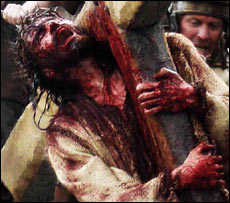
Viewers Shocked, Moved by 'The Passion'
'I just kept whispering "Dear Jesus" to myself.'
Movie theaters around the country have become temporary churches as "The Passion of the Christ" is shown.
Those who watch the relentless, brutal scourging and Crucifixion scenes say they are shocked by what they see. They also are coming away with a deeper love and appreciation for Jesus Christ, the man who died for their sins.
The movie opened Feb. 25 on more than 4,000 movie screens in more than 3,000 theaters nationwide, and it grossed more than $20 million the first day.
"It's a wake-up call for a whole lot of Christians in name only [who] have no idea what Jesus, founder of the church, went through," New Testament scholar Craig Evans told The Christian Science Monitor.
"What's going to shake up a lot of conservative Christians is the humanity of Jesus, but that's part of who He is – human and divine – and I give [producer and director] Mel Gibson credit for showing that humanity in a Jesus who's scared."
At a minimum, "The Passion of the Christ" "reminds viewers that Christianity was born out of blood, pain and tears – a far more gritty reality than a Thomas Kinkade painting or a Precious Moments nativity scene. This is no small lesson to a culture whose crosses are studded with diamonds instead of splinters," Steve Beard of United Methodist News Service wrote.
"Is there too much gore and violence in 'The Passion'? Probably," Beard wrote. "It made me turn my head. I just kept whispering 'Dear Jesus' to myself throughout many of the scenes. It is the most brutally violent and simultaneously holy thing I have seen."
Some viewers said they felt they were not merely watching a movie, but experiencing it – as if they were there with Jesus.
"I felt like I was there, pushing along with the masses down the crowded street, curiously following Christ as he carried His cross to the crucifixion site," Southern Baptist leader James T. Draper Jr. told Baptist Press. "I've read the Gospels thousands of times throughout my life, but this was the first time I'd actually stepped into them."
Reviewer Richard Roeper called the film "the most powerful, important and by far the most graphic interpretation of Christ's final hours ever put on film."
The R-rated movie dramatizes the last 12 hours of Jesus' life, drawing on Gospel accounts. It depicts Jesus being betrayed, falsely charged, mocked, whipped and flogged until it seems impossible that He survived long enough to go to the cross. By the time the crown of thorns is pounded onto Jesus' head and the cross placed onto His shoulders, He is "all but unrecognizable, a mass of flayed and bloody flesh, barely able to stand, moaning and howling in pain," The New York Times said.
In theaters across the country, viewers were horrified by the savagery of the raw images.
People groaned as the actor playing Jesus was nailed to the cross. They wept during more than an hour of Jesus' torture, crucifixion and death, and quietly celebrated as He rose from the grave.
The movie also shows Jesus being tempted by a pale, hooded figure who whispers to Him, suggesting that bearing the sins of the world is too much and that He should turn back.
Baptist minister Rick Pierce, 53, who watched the film in Plano, Texas, was in tears. "It's the kind of crying knowing that somebody would do something for me, even though I didn't deserve it. It's the greatest love story there is," he told The Associated Press.
"I think if you're a Christian it will increase your faith tenfold in what Christ has done for you," said Joseph Camerieri, 39, of Los Angeles. "I'm in shock. I'm physically weak. I'm emotional."
The film causes viewers to consider the meaning of Jesus' sacrifice.
"You've never seen anyone in a movie suffer so much," John Dominic Crossan, a leading Jesus scholar, told the Monitor. "This raises something about the heart of Christianity in a way that no other movie ever has."
In Christian doctrine, only the perfect Savior could accomplish the atonement by taking the world's sins on Himself. Gibson, a Roman Catholic, shows the prophecy of Isaiah 53:5 at the outset: "He was wounded for our transgressions, [and] by His wounds we are healed."
Some viewers said they were concerned that the movie's fixation on suffering pushes into the background Jesus' earlier ministry and later resurrection, which provide context for why He died and what that death accomplished.
"The Passion of the Christ" "never provides a clear sense of what all the bloodshed was for, an inconclusiveness that is Mr. Gibson's most serious artistic flaw," wrote the Times.
The newspaper condemned the film as half "horror movie" and half "slasher film" and likened its cruelty, brutality and violence to that of Quentin Tarantino, known for directing "Pulp Fiction" and the more recent "Kill Bill."
Some Jewish viewers called the film anti-Semitic.
About three-dozen Jewish demonstrators rallied in front of a Times Square movie theater. A New York state assemblyman and member of the City Council led the crowd, which carried signs reading "The Passion is dangerous," "To incite violence is to commit violence," and "The Passion is a Lethal Weapon," a reference to Gibson's series of violent action movies, Reuters reported.
"I was horrified. It was beyond anything that I imagined prior to seeing the film," said Assemblyman Dov Hikind, a Democrat from Brooklyn. "It really is a blood libel against Jews. Mel Gibson has done a tremendous disservice to the real message of Jesus, which is about love."
Reviewer Roger Ebert said the movie is not anti-Semitic.
It "focuses relentlessly on the price that Christ paid for redemption and it emphasizes that Jesus wanted this to happen," Ebert said. "His death was the instrument of His purpose, and we should be grateful to Him instead of critical of those who were the instruments of His will."
Southern Baptist leader Draper said that "behind many of the barbed questions posed by media types is an open hostility to Jesus Christ and His exclusive claim that He is the only path to God and eternal life."
People don't like being told that "they are not the center of their universe. In a world bent on tolerance, 'The Passion of the Christ' shatters the illusion that religion is a personal preference. ... Many people are offended by it. They should be. I am. It was a horrible death," Draper said.
"I challenge them to look beyond their bias and objectively weigh the message of the film. I ask that they simply consider while they're watching: ' What if this is true?' Viewers willing to ask that single question open themselves to truth," Draper said.
Will the violence in the movie "have the effect of shock therapy on a nation where even most confessing Christians no longer believe in the basic tenets of their faith?" Uwe Siemon-Netto of United Press International asked.
"Will it shake this highly religious nation, whose abortion rate per 1,000 women aged 15 to 44 is three times as high as Germany's and almost 10 times as high as India's? Will it bring sense to a land that celebrates what the Bible declares an abomination in God's eyes to the point of consecrating an open homosexual cleric as bishop?"
Viewers of "The Passion of the Christ" agree that they witnessed an extraordinary event that could, as Orthodox Rabbi Daniel Lapin has predicted, "propel vast numbers of unreligious Americans to embrace Christianity. The movie will one day be seen as a harbinger of America's third great religious awakening."



 Search:
 Subscribe:
 Email or