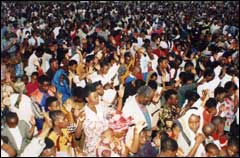
Evangelists Rally in Islamic Capital
6,000 become Christians in Khartoum, Sudan.
A door opened for the gospel late last year in Khartoum, the capital of Sudan and headquarters of its Muslim-controlled government.
During a remarkable week, a team of 20 evangelists from across Africa preached in churches, evangelized at public rallies and taught pastors in meetings. As a result, 6,000 people professed first-time faith in Christ.
The meetings, which took place in the beginning of December, occurred at a time of significant progress toward ending the country's horrific civil war.
Fighting between the mainly Islamic North and the mainly Christian and animist South has dragged on for 20 years, killing 2 million people and uprooting 4 million more in the African country. Many have fled the fighting in the South and now live in the North.
Most events were held in the slums and refugee settlements on the edge of Khartoum, while others took place in the center of the city, said Michael Cassidy of African Enterprise, who spoke at several of the venues.
Meetings for the pastors presented "an astonishing opportunity in the Lord to bless and encourage these dear men and women," most of whom were black southern Sudanese refugees. When the pastors got into groups, "the praying was loud, intense and anguished," said Cassidy, who addressed a public rally, spoke to pastors, preached at an Anglican cathedral, and met with academic faculty, heads of nongovernmental organizations and government officials.
At an open-air rally of about 3,000 people, the audience surprised Cassidy by beginning to come to the front when he was only 10 minutes into his message. When the formal appeal was made, about 350 people came to the front.
As people came forward, Cassidy's African bodyguard moved next to him and surveyed each one, "intent on discerning whether those coming forward were dedicating or rededicating themselves to Christ or to taking out the preacher."
Seventy-two counselors spent a long time praying for people who indicated their decision to become a follower of Jesus Christ. Thousands of other people who had suffered from mental or emotional traumas or family problems or who needed physical healing received prayer.
"Our evangelists would pray for people for up to one-and-a-half hours after each meeting and would be totally played out at the end of it all," Cassidy said. "Many of the team were totally traumatized after praying for, encountering and counseling over some of the desperate and traumatic needs in these different lives."
The evangelists gathered "truly amazing stories of healings, deliverances from demonic manifestations … and ever so many people came forward, bringing witch-doctor material or charms or medicines given by witch doctors to bring about miscellaneous cures or conception or healing."
The public burning of witch-craft materials was common, and "there was one astonishing testimony from a former witch doctor the night after her conversion. She had been completely delivered from the demons and was rejoicing with all her heart in the Lord," he said.
There was often "much heaviness" in the meetings when they began, but as the praise and worship got going "and as the Lord began moving amongst His people, so often the mood gave way to ecstatic worship and an almost frenzied praising of the Lord. Maybe it was a case of the 'mantle of heaviness giving way to the garment of praise.' "
In all, the evangelists addressed 22,000 people.
They said they learned important lessons from the Sudanese church.
In virtually every place the evangelists went, groups of intercessors had been praying for that particular meeting throughout the previous night and much of the morning and afternoon of the meeting.
The evangelists found a church in which the entire congregation fasts and prays for 40 days three times a year. Once a year, "the entire church closes for a month and every Sunday the whole congregation goes out evangelizing and winning people to Christ through personal witness," Cassidy said. At the end of that month they bring all the new converts back into the church to be discipled.
"It's lovely how in these places that are not bound by tradition or convention, believers are able to break out of molds, change the paradigms and do the unthinkable," he said.
Cassidy also preached on the edge of Khartoum in a small shack church holding 50 people. Its structure was made of torn cloth and canvas with a few 6-foot stumps at the corners and down the center to hold it all up.
"I was so thankful after a week of ministering in the city center ... to be in this very broken, marginalized, shattered and desperate place. I found it very precious indeed and incredibly humbling. In fact I was overwhelmed when the pastor who had fetched us announced without apology or embarrassment: 'This is my church. This is where I am pastor,' " Cassidy said.
The church had been bulldozed twice and recently was rebuilt for the third time.
"To be honest, I had to abandon my prepared talk and hardly knew what to speak on. In the end I found coming into my soul the story of Jesus' ministry on the edge of Sychar to the broken, rejected, outcast and marginalized Samaritan woman," Cassidy said.
Later, the church's pastor and the interpreter lamented the state of the Western church. They said that not a day goes by in Khartoum without radio, television or mosque loudspeakers ridiculing Christianity for allowing homosexuality among its leadership.
Many of the Christian believers "find this dreadfully depressing and find it terribly difficult to know how to respond," Cassidy said. "They feel the Western church is often really letting the side down and failing the Lord in these things."
After seeing the standard of Christian life and witness in Sudan, "one couldn't help feeling that in many instances our Christian witness in the West is indeed flabby, effete and pitifully far from the rigors of true biblical faith and life. In that I surely include my own witness," he said.
Franklin Graham of Samaritan's Purse also has been impressed by the faith of Sudan's Christians.
"The Christians I met in Khartoum are shining examples of God's peace. After decades of persecution, their churches are more vibrant and numerous than ever before," said Graham. His Christian relief agency has been working in Sudan without government approval, but late last year it was welcomed by Sudanese President Umar Al-Bashir to operate in the country (see religionjournal.com 12/13/03).
Many pastors who have ministered to people in northern Sudan displaced by the war plan to stay "even if peace comes and most of their congregations move back to the South. They believe that God has used the war to plant His church in the capital of Sudan," Graham said in a newsletter.



 Search:
 Subscribe:
 Email or